
Lessons
What Rudraksha Beads Actually Mean and Why They're Worn
6 min read
You see them on temple priests, wandering ascetics, office workers and teenagers. Brown, rough-skinned beads strung on a thread, worn around the neck or wrist, or turned slowly between the fingers during prayer. They are rudraksha beads, and they are among the most recognizable signs of devotion to Shiva.
They are also among the most misunderstood. Part of the tradition is beautiful and simple. Part of the modern market is not. This lesson separates the two.
What a rudraksha is
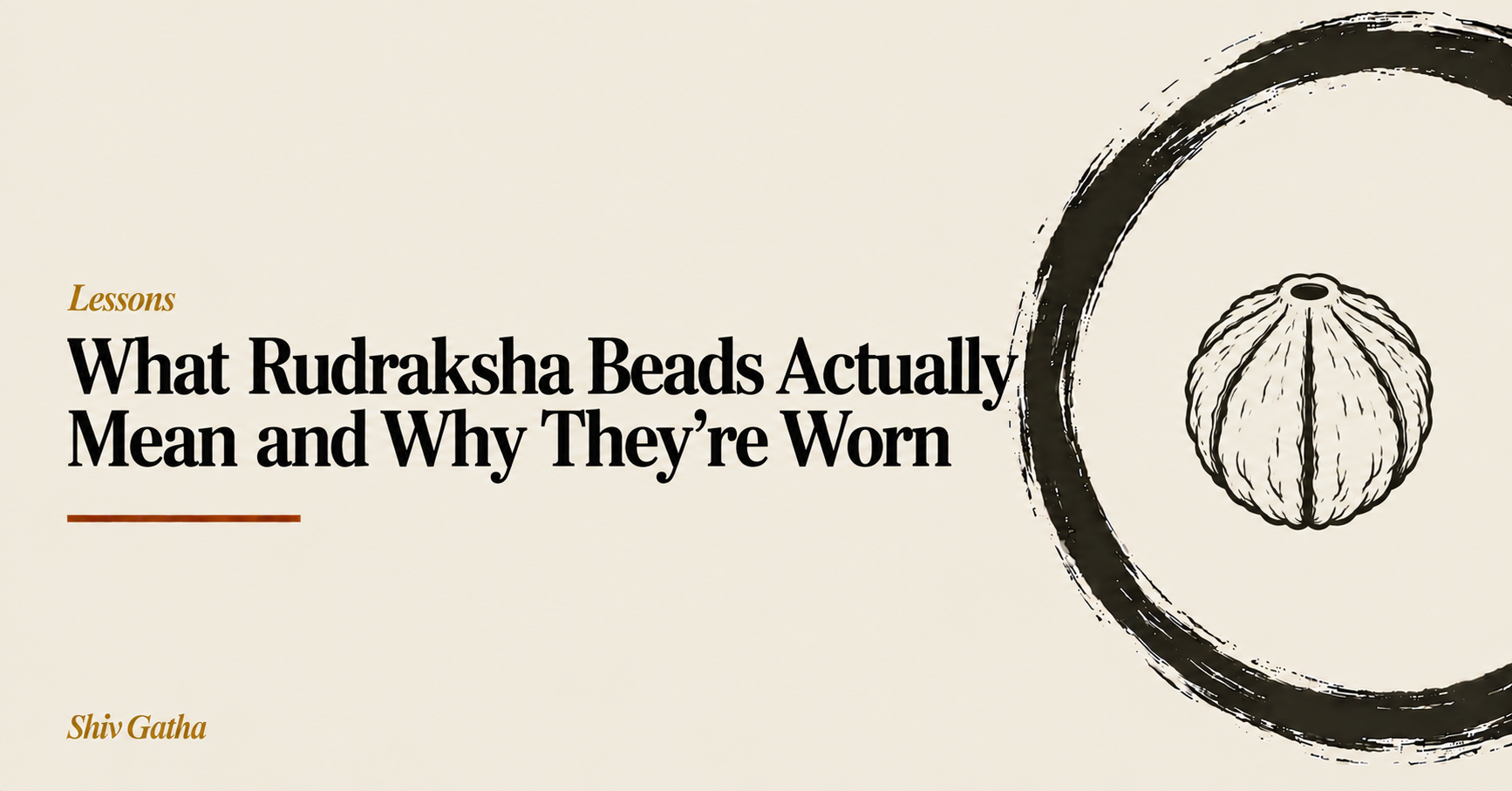
A rudraksha is the seed of a tree, usually Elaeocarpus ganitrus, which grows in the Himalayan foothills, in Nepal, and in parts of Southeast Asia, notably Indonesia. The seed is hard, round and covered in a ridged surface. When cleaned, it is the bead you see in a mala.
The word comes from two Sanskrit parts: Rudra, a name of Shiva, and aksha, which can mean "eye" or "tear." So rudraksha is usually translated as "the eye of Rudra" or "the tears of Rudra."
The story behind the name
The best-known explanation is a story told in several Puranas, with differences in the details. According to it, Shiva once sat in meditation for a very long time, for the welfare of the world. When he finally opened his eyes, tears fell to the earth, and from them grew the rudraksha trees.
The story casts the bead as something born out of compassion. Whether you take it literally or as a symbol, that is the heart of why devotees treat the bead with respect. It is read as a seed of Shiva's care for the world.
What the faces mean
Rudraksha beads have natural lines running from top to bottom, called mukhis, which means "faces." The number of lines varies, and the tradition gives each count its own name and associations.
- Five-mukhi. By far the most common bead. It is the one most devotees wear, and it is associated with Shiva in his form as Kalagni Rudra. It is generally easy to find and affordable.
- Other counts. Beads with fewer or more faces exist, from one to twenty-one and beyond. Each is linked in various texts and teachings with a different deity or aspect, and the lists differ by source.
It is worth knowing that the five-mukhi is the traditional bead for ordinary daily wear and for japa. The rarer ones are valued by collectors and by some devotees, but the tradition does not say that you need one.
Why people wear them
People give a number of reasons, and it helps to keep them separate.
- As a sign of devotion. The most common reason is also the simplest. Wearing a rudraksha is a way of keeping Shiva close and being reminded of him throughout the day.
- For japa. A mala of rudraksha beads is the traditional tool for counting mantras. Each bead marks one repetition, and the circle keeps the count without needing the mind to track it. A mala usually has 108 beads, plus one larger bead called the sumeru, which marks the start and end of a round. You do not cross over the sumeru. You turn the mala and go back the other way. Some malas have 54 or 27 beads, and these are used as well.
- For calm and focus. Many people say that the weight and texture of the beads, and the rhythm of counting, help them settle. This is an experience that many practitioners describe, and it needs no particular belief. A repeated physical action can anchor a wandering mind.
- For protection and blessing. Traditional texts describe the rudraksha as a protective object. This is a matter of faith, and it is a reason to wear it respectfully, not a promise of outcomes.
What not to believe
This is the part worth saying plainly.
- Health claims. You will often see rudraksha sold with claims about blood pressure, the heart, stress or other medical benefits. These claims are not established by medical evidence. If you have a health concern, see a doctor, and treat the bead as a devotional object, not a treatment.
- Rare beads and large prices. Beads with unusual face counts are sometimes sold at very high prices with promises of success or wealth. Nothing in the tradition says you need an expensive bead. Devotion matters more than rarity.
- Fake and altered beads. Fake beads are common. Some are carved or glued to look like a rare bead, and some are plastic or wood. A common home test is dropping a bead in water to see if it sinks, but this is not reliable. If a bead matters to you, buy from a reputable seller, and be wary of anyone who promises a guaranteed result.
How it is usually worn
Practice varies by family, teacher and region, and the local priest's guidance always wins. A common outline looks like this:
- Choose a bead or mala from a source you trust. A simple five-mukhi mala is enough.
- Clean it gently with water, and if you like, rub a little oil on it. Let it dry.
- Offer it to Shiva. Many people place it before an image or lingam, and chant Om Namah Shivaya a few times before wearing it.
- Wear it with respect. Many devotees avoid wearing it in places they consider impure, and some remove it when sleeping or before certain activities. Customs differ, and you should follow your own tradition.
- Do not hang it on the floor or leave it in odd places. Treat it like any object you value.
Many families also keep a separate mala for japa and do not wear it as jewelry. If you use a mala for counting, keep it clean and use it only for prayer.
A few practical points
- Choose by comfort. If it irritates your skin or the thread feels rough, change the thread. A comfortable mala is one you will actually use.
- Check the thread. The thread wears out, and replacing it is a small act of care.
- Use it, do not just wear it. The beads make most sense when they are doing something, counting a mantra or reminding you to pause.
What the bead teaches
A rudraksha is small, rough and plain. There is nothing polished about it, and that may be the point. It is a seed, not a jewel. In a tradition where the great god is often shown covered in ash and sitting on a bare mountain, it makes sense that his symbol is an unfinished-looking seed.
Worn well, it is not a charm or a promise. It is a reminder, one you can hold in your hand.
Want to see how a mala is used with a mantra? Read: Shiva Panchakshari Stotram: Meaning Behind the Five Syllables.
Collecting mantras? Download the free Mantra Meanings e-book from our Downloads page.