
Reflections
Dealing With Loss: What Neelkanth Teaches About Absorbing Pain
4 min read
Nobody warns you about the shape of grief. People talk about the first week, the funeral, the flowers. Nobody mentions the ordinary Tuesday, months later, when something small brings it all back and you are standing in a kitchen with your hand on a cup.
I have been thinking about loss through the figure of Neelkanth, the blue-throated one. Not because Shiva makes grief go away. He does not. What his stories offer is something more honest: a picture of what it looks like to carry pain without being destroyed by it, and without pretending it is not there.
Shiva was not spared
It is easy to imagine the great Lord as untouched by sorrow. The stories say otherwise.
In the best-known telling, Sati, his first wife, dies after a painful conflict with her father, Daksha. Shiva's response is not calm detachment. He is shattered. In many versions of the story, he lifts her body and wanders with it, unable to put it down. The tradition remembers his grief so strongly that it tells of the Shakti Peethas, sacred sites said to mark where parts of her body fell as he carried her.
Versions of this story differ across texts and regions, so hold the details lightly. What stays the same is the picture: the Lord of the universe, undone by loss. If Shiva can grieve like this, nothing is wrong with you for doing the same.
The poison and the throat
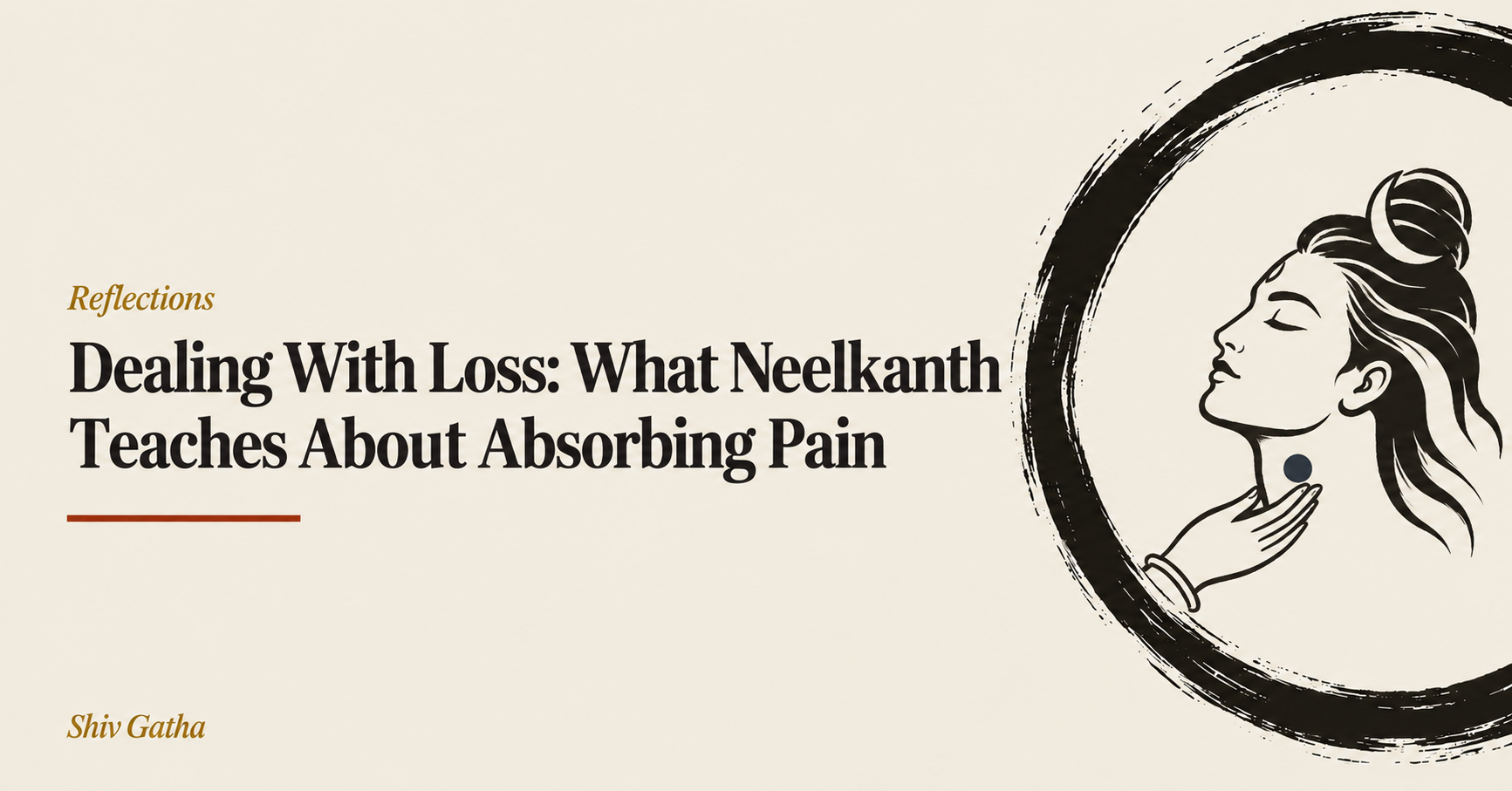
Then there is the other story, the one that gives him his name. When the gods and demons churned the ocean, a terrible poison, Halahala, rose up and threatened to destroy everything. Shiva drank it. The story says that Parvati's hand rested on his throat, and the poison stayed there, turning his neck blue.
I wrote about this story in a reflection on letting go. Here I want to look at it from a different side, the side of someone carrying pain they cannot hand to anyone else.
Two ways to get it wrong
Look at what Shiva does not do with the poison:
- He does not swallow it. If it went all the way down, it would consume him from within.
- He does not spit it out. If it fell, it would harm everyone around him.
Grief offers us the same two bad options. We can swallow it, push it down, stay busy, say "I'm fine" until the words stop meaning anything. Or we can let it spill onto the people nearest to us, in anger, in withdrawal, in a sharpness that was never meant for them.
The story points to a third way. Hold it. Keep it where it can be seen and felt, but do not let it run through you or over everyone else.
The hand on the throat
I keep returning to the detail of Parvati's hand. In the story, Shiva does not hold the poison alone. Someone's hand is on his throat.
For me this is the most useful part. Pain held in isolation is heavy. Pain held with another person is still pain, but it is held. Grief does not ask you to be strong by yourself. It asks you to let someone place a hand where it hurts.
What the blue means
The throat stays blue. The poison is not erased. In the tradition, Neelkanth is not worshipped in spite of the mark but because of it. The blue is the evidence that he took something hard and did not deny it.
I find this oddly comforting. Loss leaves a mark, and the mark does not have to be hidden. Over time it can become part of who you are, not a wound that stays open, but a quiet place in the throat where something once was held. People who have loved someone deeply tend to carry that mark, and it says something good about them.
A few small practices
None of this is a cure. Grief takes the time it takes. But these are things that help me stay in the third way:
- Say it out loud. To a friend, to the picture of Shiva, to the empty room. Pain that is spoken does not have to be swallowed.
- Pick one person. Not everyone, just one, who can hear the hard thing without trying to fix it.
- Light a lamp for the person you lost. A small one, once a week or on days that are heavy. It gives the feeling somewhere to go.
- Chant Om Namah Shivaya slowly, on the exhale. You do not have to feel anything. Just breathe and say the words. Some days that is the whole practice.
- Let ordinary things in. Eat, walk, sleep. Holding pain is tiring work, and you need strength for it.
A gentle note
If your grief has become heavy enough that you cannot function, or you feel unsafe, please reach out to a counselor, a doctor or someone close to you. A hand on the throat can be a friend's, a family member's or a professional's. There is no weakness in that.
What Neelkanth teaches
He teaches that you do not have to choose between pretending the pain is gone and being swallowed by it. You can hold it, with care, for as long as it needs to be held. And you do not have to hold it alone.
Looking for more on carrying what you cannot change? Read: Letting Go of What You Can't Control: A Shiva-Inspired Reflection.