
Stories
Samudra Manthan: How Shiva Drank the Poison to Save the Universe
4 min read
Of all the stories told about Shiva, this is the one that gives him a name. Neelkanth, the blue-throated one, is the Lord who held the world's deadliest poison in his throat so that no one else would have to.
The story is called Samudra Manthan, the churning of the ocean. It is told in the Puranas and in the Mahabharata, in several versions that differ in their details. The version below follows the most common telling.
How it began
The devas, the gods, had lost their strength. In many tellings, this followed a curse from the sage Durvasa on Indra, king of the gods, after Indra treated a garland he had been offered with disrespect. With the gods weakened, the asuras, their rivals, grew powerful, and the world fell into disorder.
The gods went to Vishnu for help. His advice was surprising. He told them there was a way to regain their strength: the ocean of milk held amrita, the nectar of immortality. But the gods could not churn the ocean alone. They would have to ask the asuras to join them, and promise them a share.
It was an uneasy alliance, and both sides knew it.
The great churning
The plan needed three things:
- Mount Mandara, to serve as the churning rod.
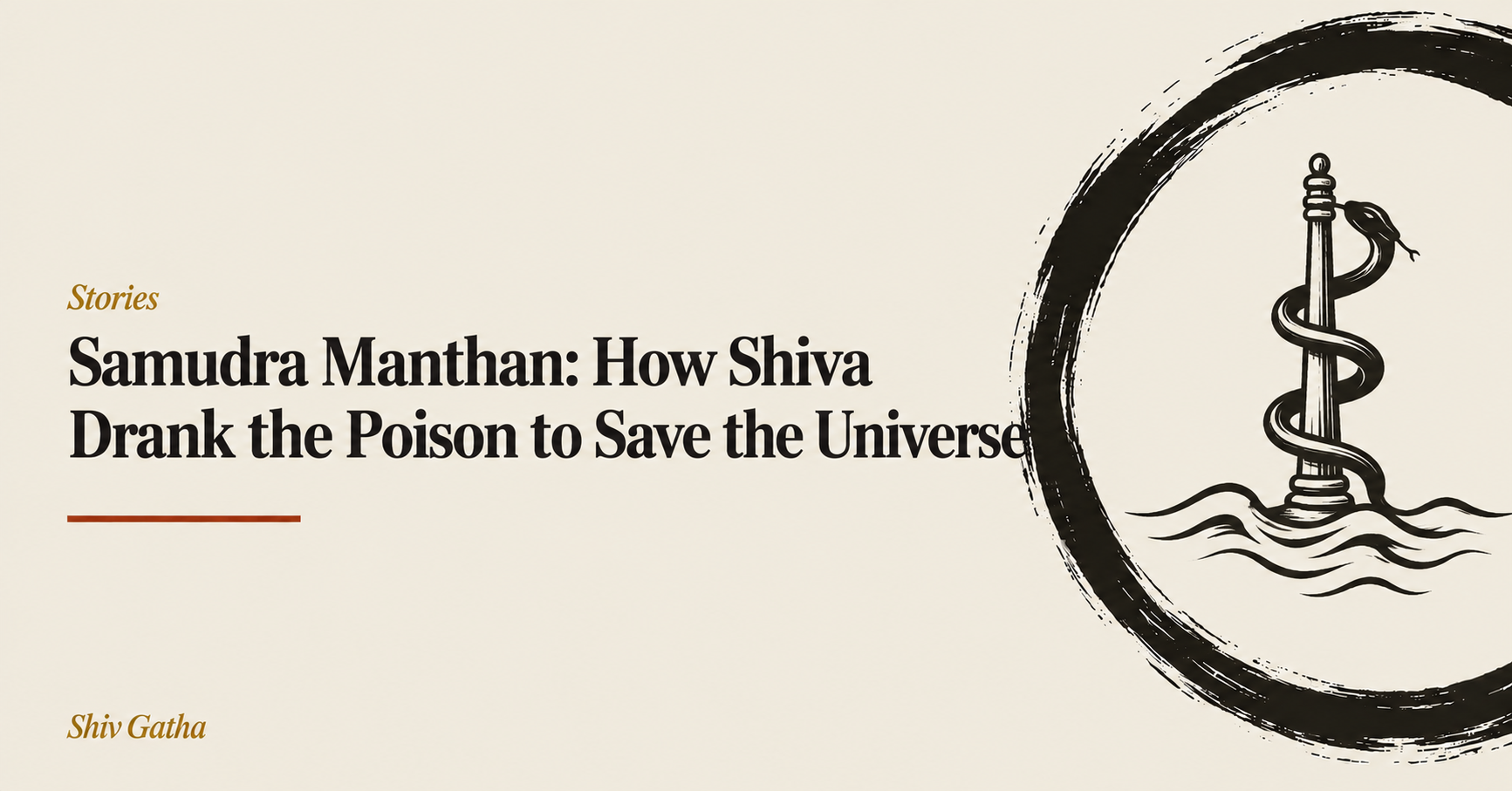
- Vasuki, the great serpent who rests around Shiva's neck, to serve as the rope.
- A firm base to hold the mountain in the water.
When the mountain began to sink into the ocean, Vishnu took the form of a great tortoise, Kurma, and held it up on his back. The devas took one end of Vasuki and the asuras the other, and they pulled back and forth, back and forth, until the ocean began to churn.
It went on for a long time. The ocean gave up its secrets slowly.
The poison
Before any treasure came, something terrible rose to the surface. It was a dark, burning poison called Halahala. Its fumes spread through the sky, scorching the sea and choking every creature in reach. Gods and demons alike ran. Nobody could stand against it, and nobody could stop it.
They turned, as people do when they have run out of options, to Shiva.
What Shiva did
Shiva did not hesitate. He cupped the poison in his hand and drank it.
But Parvati, who was watching, was afraid. In the story, she reached out and pressed her hand to his throat. The poison did not go down into his body, and it did not come back up. It stayed at his throat, which turned blue. From that day, he was called Neelkanth, from neel (blue) and kanth (throat).
In some tellings, a few drops spilled, and these are said to have become the source of certain poisonous creatures and plants. Details vary, so treat this as one of the story's folk additions.
What came after
With the poison gone, the churning began again, and the ocean now gave up its treasures one by one. The exact list and order change between texts, and fourteen jewels (ratnas) is a common count. Among the most often named are:
- Kamadhenu, the wish-fulfilling cow.
- Airavata, the white elephant.
- Parijata, the heavenly tree.
- Lakshmi, who chose Vishnu.
- Chandra, the moon. In several tellings, Shiva took the crescent moon to wear in his hair.
- Dhanvantari, the divine physician, carrying the pot of amrita.
The final prize was amrita itself. The asuras tried to take it for themselves, and Vishnu, in the form of Mohini, an enchanting woman, tricked them and ensured the gods received the nectar. The gods regained their strength.
Why this story matters
Look at what happened in order. Everyone wanted the nectar. The poison came first. Only one being was willing to take it.
That is the point many devotees take from this story. The things we want, such as security, success and peace, often come only after something hard has been dealt with, and someone has to deal with it. Shiva is the one who does it without being asked twice, and without asking for the nectar afterward.
He took the poison and left the amrita to the gods. In popular tradition, this is why he is also called Bholenath, the Lord who gives freely and wants little.
How the story lives on today
The story is remembered in several ways:
- Pradosh Vrat. Many devotees link the twilight hour of Pradosh to this event, the time when Shiva is said to have drunk the poison, and fast and worship Shiva then.
- The blue throat in images. Almost every picture of Shiva shows the blue throat, as a reminder of the story.
- Maha Shivratri. Some traditions also connect the night of Shivaratri with the poison, though accounts of its origin differ.
- Temples. Several temples are dedicated to Neelkanth, and many daily prayers use the name.
A story to sit with
Samudra Manthan can be read as a story about gods and demons. It can also be read more quietly, as a story about what it takes to keep going when something goes wrong. The poison does not vanish. It is held, with care, and the work goes on.
Want to see where this name sits among the others? Read: Shiva's Many Names: Mahadev, Rudra, Bholenath, Shankar Explained.
Observe the evening Shiva is said to have drunk the poison? Download the free Pradosh Vrat Guide.