
Rituals
The Meaning Behind Circumambulating a Shivling (and Why Not Fully)
4 min read
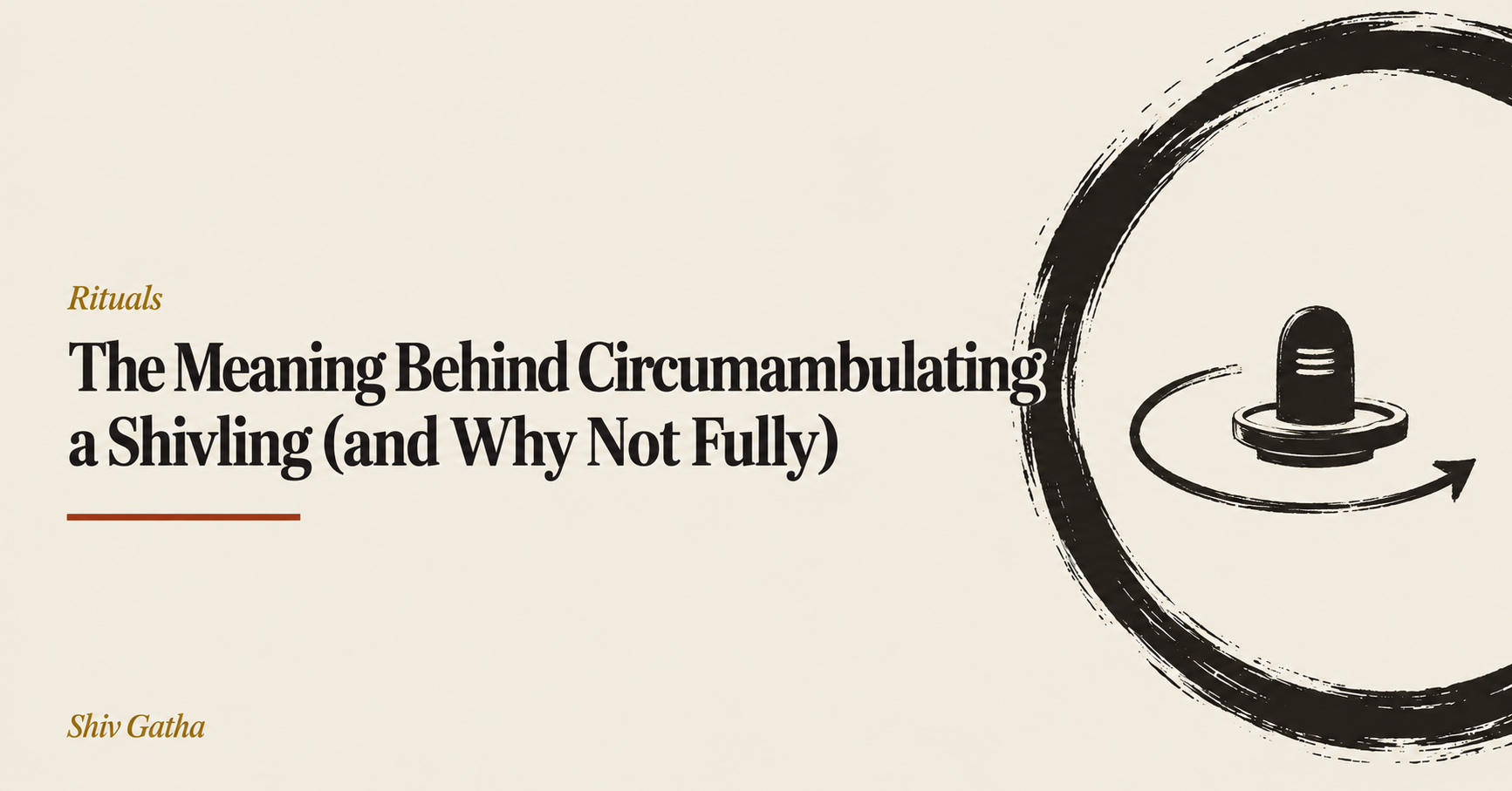
Walk into almost any Hindu temple and you will see people circling the deity, slowly, with hands folded. In a Shiva temple, though, you may notice something odd. The devotees walk part of the way around the Shivling, stop, turn back, and walk the other way. Nobody completes the circle.
If you have ever wondered about it, you are in good company. It is one of the most common questions first-time visitors ask, and the answer is a small, careful piece of ritual logic.
Pradakshina: why we walk around
Circumambulation is called pradakshina. The word points to the right side (dakshina), because you keep the deity on your right as you walk, which in practice means moving clockwise. It is found across Hindu worship, and in Buddhism and Jainism too.
The idea behind it is simple. You are not just visiting the deity, you are placing the deity at the center of your own movement. Walking around the sanctum, you orbit it, much the way the day orbits the sun. Most devotees describe it as a way to keep prayer going after the words stop.
What is different at a Shivling
A Shivling is usually set on a base called the peetha, and the base has a small channel or spout on one side, the somasutra (also called the gomukhi). It is where the water, milk, and other offerings poured over the lingam during abhishekam flow out and away.
In Shiva temples, the usual rule is that you do not step over that channel. That is the reason the circle is never completed. The custom is often called somasutra pradakshina, and is sometimes known as chandi pradakshina.
How it is usually done
Customs differ from temple to temple, and the local priest's guidance always wins. But a common pattern goes like this:
- Start near the spout and walk clockwise, keeping the lingam on your right, until you reach the spout from the other side.
- Do not cross it. Turn around and walk back the way you came, now moving the other direction around the lingam, to where you began.
- Then repeat in the opposite direction, again stopping at the spout and turning back.
So the walk is made of two half circles, one on each side, and the spout is never stepped over. Many devotees do this three times. Some do one round, others five or more.
Why the spout is not crossed
There is no single official explanation, and it is better to say so. These are the reasons most often given:
- Respect for what flows out. The water, milk, and honey poured over the lingam are treated as sanctified by the contact. Stepping over the channel they flow through is seen as a lack of reverence, the way you would not step over an offering.
- Not disturbing what the lingam is believed to hold. Some traditions say the lingam's power is carried out through the spout, and crossing it interferes. This is a matter of belief, not something that can be measured, and it is fine to hold it as such.
- Discipline. A ritual with one small restriction teaches attention. You cannot do it on autopilot. You have to notice where you are.
Whichever explanation speaks to you, the practice is the same.
A few practical notes
- Walk slowly, and let your mind settle on the mantra rather than the route.
- Chanting Om Namah Shivaya quietly while you walk is common.
- In a crowded temple, follow the flow and do what you can. Nobody expects a perfect circuit in a queue.
- At home, if your Shivling has a spout, the same logic applies. If you are not sure how to do it, keep it simple: offer your prayers facing the lingam, and save the pradakshina for when you are at a temple with a priest who can show you.
What the half circle teaches
I find something fitting in a circle that is deliberately left open. Shiva is the one who has no beginning or end, and yet the ritual built around him has a gap in it, a place you do not go. It is a small reminder that devotion is not about completing everything. Sometimes it is about knowing where to stop.
Curious about what flows through that spout? Read: Why Milk, Water, and Honey Are Offered to the Shivling.
Want a step-by-step version to keep by your altar? Download the free How to Perform Abhishekam printable guide.