
Stories
Shiva as Nataraja: The Cosmic Dance Explained
Of all the ways Shiva is depicted, Nataraja, the Lord of Dance, is arguably the most artistically iconic. Bronze statues of this form sit in museums worldwide, often admired purely for their aesthetic power. But behind the striking pose is one of the densest pieces of symbolism in the entire tradition, every element of the sculpture is doing philosophical work.
The pose itself
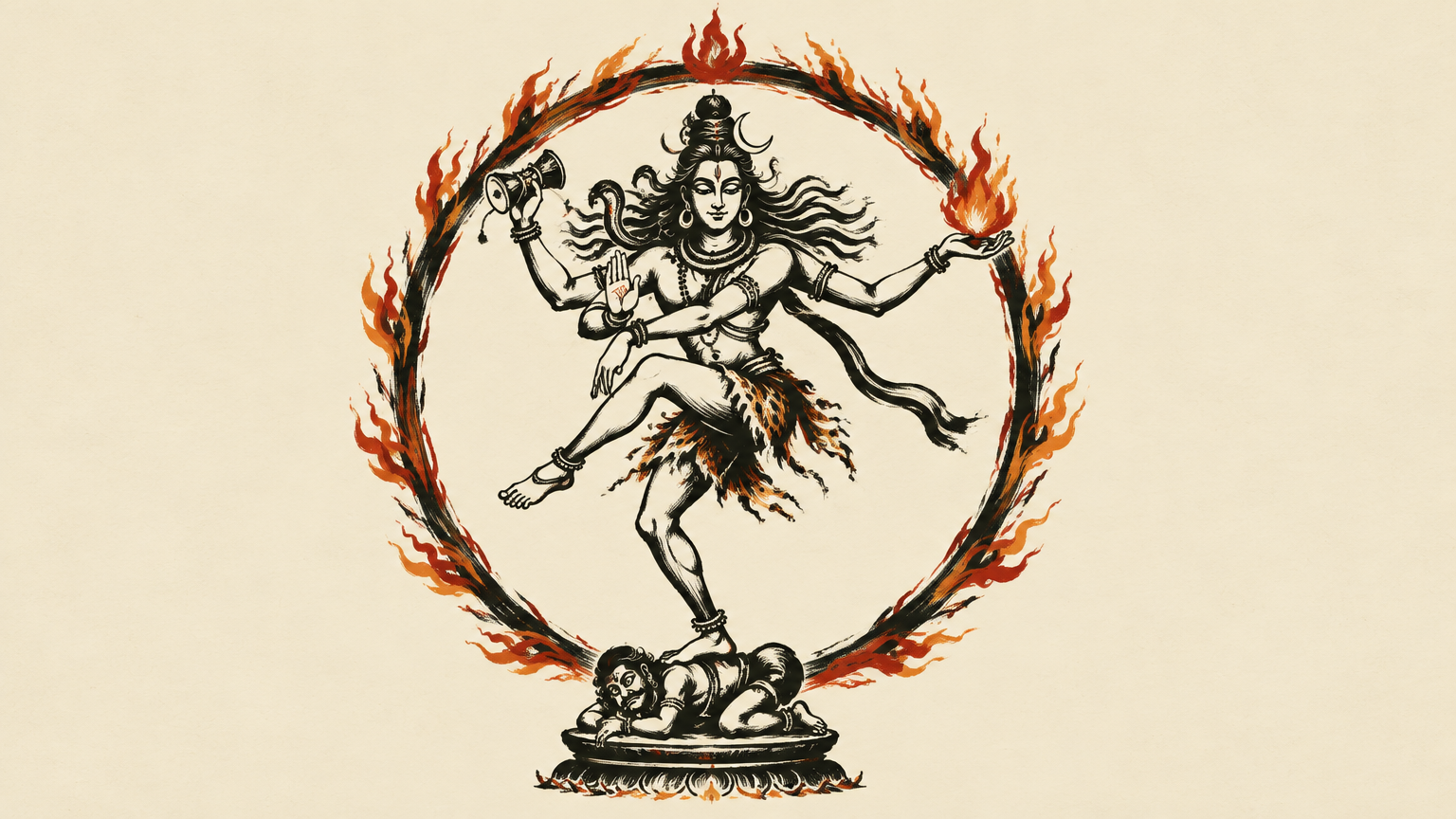
Nataraja is shown mid-dance, one leg raised, the other planted on a small demon-like figure beneath his foot. Four arms extend outward, each holding or gesturing something specific. A ring of fire surrounds the entire figure. None of this is decorative flourish, each detail maps to a distinct idea.
What each element represents
The raised leg symbolizes liberation, spiritual release from the cycle of rebirth (moksha), lifted free of the ground that represents worldly bondage.
The figure being trampled, a dwarf-like demon called Apasmara, represents ignorance and forgetfulness. Shiva doesn't destroy Apasmara outright, he dances upon him, suggesting that ignorance isn't eliminated so much as kept perpetually subdued beneath awareness.
The damaru (drum) in one upper hand represents the sound of creation, the primordial rhythm from which the universe emerges. Some traditions hold that the very structure of Sanskrit grammar originated from the drum beats of Shiva's cosmic dance.
The flame in another hand represents destruction, the fire that eventually consumes all created things, completing the cycle the damaru begins.
A third hand is often shown in abhaya mudra, a gesture of reassurance, meaning "fear not." Even amid the cosmic forces of creation and destruction represented in his other two hands, this gesture offers protection and calm.
The fourth hand points toward the raised foot, directing attention to the path of liberation itself.
The ring of fire (prabhamandala) surrounding the whole figure represents the entire cosmos, the boundary within which all of this creation, destruction, ignorance, and liberation continuously plays out.
Why a dance, specifically
Choosing dance as the metaphor for cosmic activity is a deliberate choice, not an incidental one. Dance is rhythmic, repeating, and temporary, each movement arises and dissolves to make way for the next. That's precisely how this philosophy understands the universe itself: not a fixed, static creation, but a continuous performance of arising and passing away, moment to moment, cycle to cycle.
This dance, called the Ananda Tandava, the dance of bliss, is generally distinguished from Shiva's more fearsome Rudra Tandava (the dance of destruction, performed in grief or fury). Nataraja's version is calmer, more balanced, a controlled expression of cosmic rhythm rather than uncontrolled devastation.
Where this form comes from
The Nataraja form is closely associated with Chidambaram, a temple in Tamil Nadu considered one of the most significant sites of Shiva worship specifically for this aspect. Tradition holds that Chidambaram is where Shiva performed this cosmic dance, and the temple's inner sanctum is built around this exact form, making it a pilgrimage destination distinct even among other major Shiva temples.
The artistic form itself reached its most refined expression under the Chola dynasty, whose bronze Nataraja sculptures, cast roughly a thousand years ago, remain some of the most celebrated works of art in Indian history, studied as much for their engineering and craftsmanship as their spiritual meaning.
A single image, a complete philosophy
Few religious images pack this much meaning into one static form. Creation and destruction, ignorance and liberation, fear and reassurance, all held simultaneously in a single dancing figure. Nataraja isn't just an artistic representation of Shiva, it's arguably the most complete visual summary of everything Shaivite philosophy is trying to say.
Curious about the temple most closely tied to this form? Chidambaram Temple: Where Shiva Dances as Nataraja is coming soon to Shiv Gatha. Until then, explore The 12 Jyotirlingas: A Complete Guide for more sacred Shiva sites.